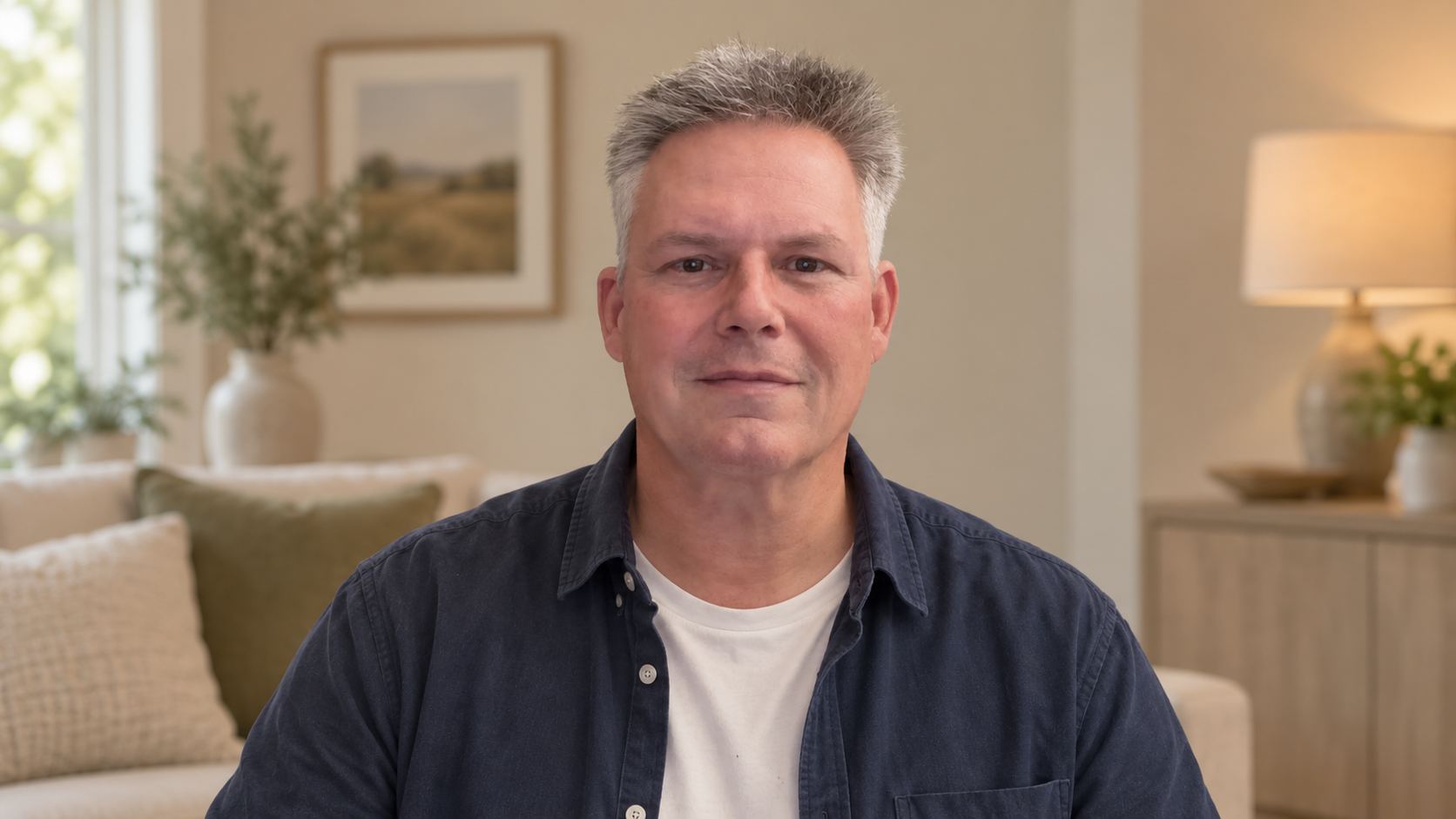
Harold Tsiamis seated in a warm home setting

“I’ve spent a lot of my life understanding other people. Some of the hardest lessons came from looking much closer at myself.”

Creator of Pattern Interrupt Protocol™

A behavioural education system for men over 40 who recognise they don’t always handle pressure the way they want to.

I’ve been immersed in working with people, responsibility and difficult decisions for decades.

But for all of that experience, there were still situations in my own life where I could look back afterwards and think, “I knew better than that. So why did I still handle it that way?”

And that’s the question I kept asking myself, because understanding afterwards what I could’ve done differently didn’t necessarily mean I’d handle it differently the next time I found myself under pressure.

Over time, I wanted to understand why.

A lot of the work I do today grew from there.

Being capable doesn’t mean you always like how you respond under pressure.

That was something I had to come to terms with in my own life.

You can be good at what you do, make difficult decisions, carry responsibility and be the person other people rely on, and still have situations where afterwards you think, “Why did I handle that the way I did?”

For me, that mattered because I wasn’t looking for an excuse, a label or another way to explain it away.

I wanted to understand why knowing better wasn’t always enough when I was in a conversation or had to make a decision there and then.

Years of working with other people gave me a perspective on that.

My own experience gave me another.

And over time, deeper study into communication, behaviour and the way people respond under pressure gave me more to work with.

Those three things eventually started coming together, not as theory for its own sake, but as a way of making sense of something I’d seen in myself and other people for years.

For a long time, what people saw on the outside and what was happening inside were two very different worlds.

I grew up in Mount Isa, a mining town in outback Queensland, Australia.

There were some great years there. I got involved in music, made close friends and had experiences I still look back on fondly.

But there was another side to it that almost nobody knew about.

I was bullied and humiliated at school from a very young age.

I worried far too much about what other people thought of me and was constantly seeking approval from others.

But I didn’t walk around telling people any of that because I became an expert at hiding it.

I just got on with life.

To most people, I was Harold. Easy to get along with, involved in things, making friends, having a laugh and doing what everybody else was doing.

My own family didn’t know about the bullying until I was in my forties.

That’s how separate those two worlds had become.

By the time I was 22, I wanted to leave Mount Isa.

People thought I was going overseas for a holiday, and in fact I was.

But in my head, I was actually escaping.

Little did I know I’d be away for 26 years before coming back to Australia to live.

The interesting thing is, leaving worked in plenty of ways.

My world got bigger. I travelled, met extraordinary people, built businesses, worked in different countries and eventually found myself in roles where people trusted me to make important decisions, solve problems and carry responsibility.

From the outside, I could look like somebody who had his shit together, and a lot of the time I did.

But intertwined with all of that were business failures, financial failures, relationship failures and periods of my life that literally felt like hell.

Sometimes things were going well. Sometimes they weren’t.

Either way, the conversations inside my head didn’t just disappear.

There were still doubts I kept to myself, times when I wanted approval more than I wanted to admit, and situations where I could appear calm and capable while something very different was going on underneath.

For years, I didn’t really see those things as connected.

They were just life.

You get on with it, deal with what’s in front of you and keep moving.

It took me a long time to realise that changing the outside of my life didn’t automatically change everything happening inside it.

That realisation became a big part of what I eventually wanted to understand.

I’ve never been interested in learning this stuff just so I could talk about it.

My interest in personal development, communication and human behaviour goes back more than 30 years.

It started in my early twenties when I came across Tony Robbins and his Personal Power programme. For the first time, I was being introduced to ideas about the way we think, behave and respond that I could actually apply to my own life.

That mattered to me, because from the beginning, I was never interested in collecting information for the sake of knowing more.

I wanted to know whether I could use it.

In 1994, while living in Singapore, I became certified as a Neuro-Linguistic Programming Practitioner through the Society of NLP under Gary Yardley, who had trained with NLP co-founder Richard Bandler.

From there, I kept learning.

Sometimes through programmes, seminars and teachers, and sometimes through the considerably less comfortable education that comes from getting things wrong in your own life and having to work out what you’re going to do about it.

But there’s been one constant through all of it.

I’ve always applied the work to myself first.

If I’m going to ask somebody else to look honestly at how they behave, I think I should be prepared to do exactly the same thing.

And over the years, some of the biggest lessons haven’t come from something I could explain intellectually.

They’ve come from recognising something in myself, applying what I was learning and experiencing the difference it made in real life.

In 2025, I stepped back into intensive study through Conscious Mastery Academy.

That eventually led to further practitioner and master-level training across Neuro-Linguistic Programming, Positive Psychology, Time Line Therapy® and Modern Hypnosis.

There are certificates that go with the training, and they’re here on the page if somebody wants to look at them.

But to me, certificates aren’t the interesting part.

What they represent is decades of curiosity about why people do what they do, a willingness to keep learning and investing in my own development, and thousands of hours spent studying, applying, questioning and testing those ideas against my own experience.

That combination matters to me because I’m not sharing something I’ve only studied, and I’m not sharing something simply because I’ve lived through it.

I’ve had the opportunity to do both. To live it, study it, apply it to myself, and then ask a much more useful question, “How do I take what I’ve learned and make it simple enough to be genuinely useful to someone else?”

A lot of what I’m building today grew out of that question.

Certified Master Practitioner in Neuro-Linguistic Programming

1994 · NLP Practitioner
Society of NLP
Harold Tsiamis

2026 · NLP Master Practitioner
Conscious Mastery Academy
Harold Tsiamis · 4 June 2026

Certified Master Practitioner of Positive Psychology

Conscious Mastery Academy
Harold Tsiamis · 4 June 2026

Certified Master Practitioner in Time Line Therapy®

Conscious Mastery Academy
Harold Tsiamis · 4 June 2026

Certified Practitioner in Modern Hypnosis

Conscious Mastery Academy
Harold Andrew Tsiamis · 12 November 2025

Pattern Interrupt Protocol™ became my way of turning what I’d learned into something practical.

The gap I kept coming back to was one I’d seen in my own life for years.

You can understand afterwards what you could’ve done differently and still find yourself responding the same way when another situation comes along.

I’d seen it in myself, and I’d seen versions of it in other people.

And the more I studied behaviour, communication and the way we respond under pressure, the more interested I became in what happens between knowing what makes sense and actually being able to use that understanding when it matters.

That’s where Pattern Interrupt Protocol™ began.

Not as another personal development programme built around telling somebody what they should think, how they should behave or what’s supposedly wrong with them.

I wanted to build something that helped a person recognise what was already happening in their own life, by looking at real situations, real conversations and real decisions, and noticing what keeps showing up for themselves.

Because I think there’s a big difference between somebody telling you what they think your problem is and recognising something for yourself and thinking, “Shit. I do that.”

That second one matters to me.

It’s why so much of the work is built around recognition first.

You’re given something real to look at, something you can compare with your own life, and enough room to decide for yourself whether it fits.

That approach came directly from my own experience.

Some of the most useful things I’ve learned over the years weren’t useful because somebody gave me the answer.

They were useful because something helped me see what I hadn’t seen clearly before.

Pattern Interrupt Protocol™ grew from wanting to create that same kind of experience for somebody else.

If any of this feels familiar, the best place to start is by seeing what you recognise in yourself.

That’s why the first step in Pattern Interrupt Protocol™ is the Pressure Pattern Assessment™.

It gives you a simple way to look at how you tend to respond when pressure is real and see whether patterns are showing up that you might not have noticed as clearly before.

You don’t need to know where any of it leads.

You just need to be willing to look honestly at what’s already happening.

Because sometimes the most useful place to begin is simply recognising something for yourself and thinking, “Yeah. I do that.”